Flexowriter
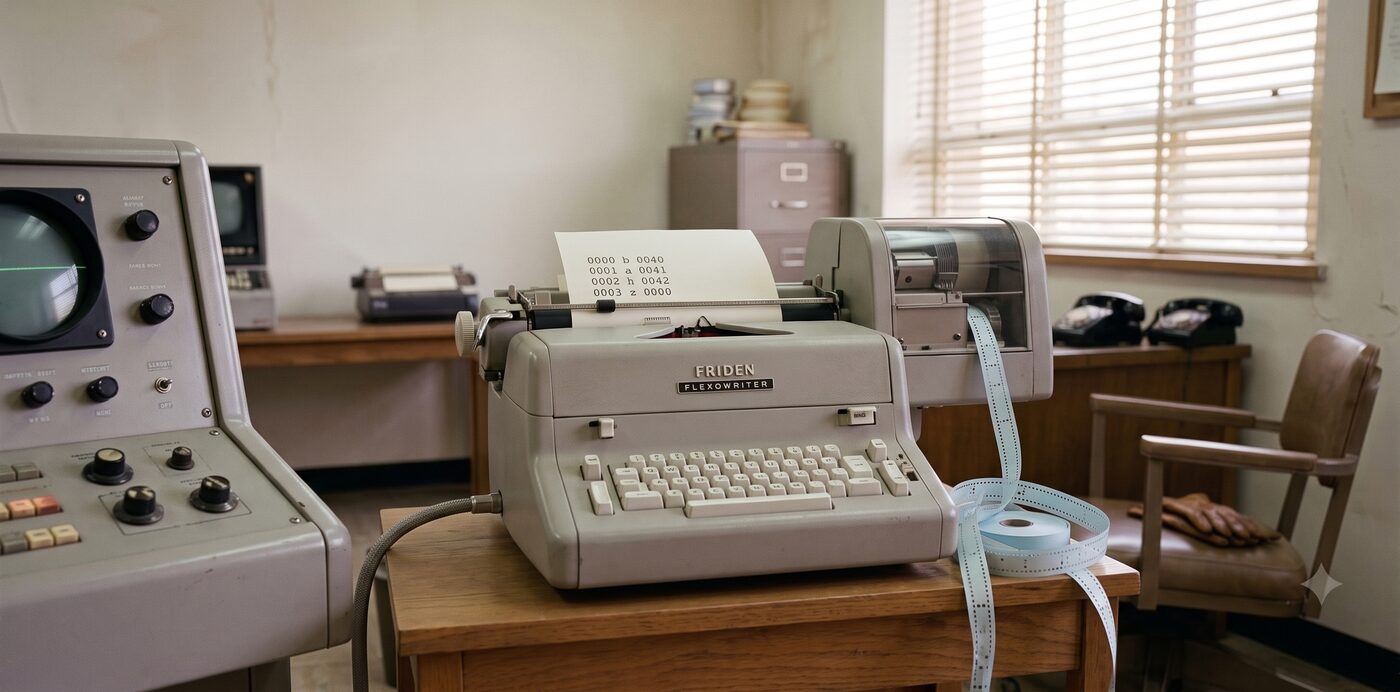
The Friden Flexowriter was a heavy-duty electric typewriter with a paper-tape reader and a tape punch built in. It was developed by the Commercial Controls Corporation of Rochester, New York, and sold under the Friden name after Friden bought the company in 1957. It was an office machine. Driven by punched tape, it typed form letters and bills by itself, with names and amounts filled in automatically.
On the LGP-30 it was the whole of input and output. Its keyboard typed programs and data in, its typewriter printed results, its reader loaded programs from tape, and its punch saved them. All of this ran at about ten characters a second.
The usual way: cards
Most computers of the 1950s read and wrote punched cards. The most widely used of them, the IBM 650, had an IBM 533 read-punch for the job. It weighed 1,295 pounds, read 200 cards a minute and punched 100. In 1956 it rented for $550 a month, on top of $3,200 a month for the computer and its power unit. The cards themselves were prepared on separate keypunch machines, with operators to run them.
The 533's rent alone came to $6,600 a year. About seven years of renting just the card reader would have paid for an entire LGP-30, which sold for $47,000 with its Flexowriter included.
Why a typewriter
The LGP-30 was built to be cheap, and the Flexowriter was one of the best savings in it. It already existed and was made in quantity, so nothing had to be designed for it. One machine did the work of four: keyboard, printer, reader and punch. And the company selling the LGP-30, Royal McBee, was the largest typewriter maker in the world, so a typewriter as the computer's front end was a natural fit.
The result was a computer that plugged into an ordinary wall socket and fitted into an ordinary office. It needed no card room, no keypunch operators and no special wiring. A university department or a small engineering firm could own one outright.
The price was speed. Ten characters a second is slow: a card reader at 200 cards a minute takes in about 270. Reading a word from tape took nine characters, eight digits and a stop code, so a program of a few hundred words took several minutes to load and a full drum about an hour. An optional photoelectric tape reader was sold for faster loading. But for the people the LGP-30 was aimed at, a machine they could afford mattered more than a fast one.
Its mark on the machine
The Flexowriter shaped the LGP-30 more than a peripheral usually does. Each key sends a six-bit code, and the machine was designed around those codes. They gave it its hexadecimal digits and its instruction letters: see LGP-30 Hex.
A program reads with p 0000, which starts the reader, followed by
i 0000. Each character read shifts four bits into the accumulator, until
a stop code ends the word and the program carries on. The console's 6-bit Input
switch changes this: each character then shifts in all six bits of its code, so a
program can read text as well as numbers.
The tape had six code channels and a smaller feed hole. Across the tape the channels ran 6, 1, 2, then the feed hole, then 3, 4, 5, and the machine took them in the order 1 to 6. An operator could also skip the tape: with the Manual Input switch on the typewriter pressed, keys went straight to the machine, and the Start Compute lever ended the word.
Output had its own limit. The typewriter took a tenth of a second per character, and a print order that arrived before it had finished was lost. Programs waited between prints, either by computing for at least five and a half drum revolutions or by stopping until the typewriter signalled that it was done.
In the IDE
The debugger's Flexowriter band stands in for the machine. What the program prints is typed onto paper. With Manual input on, you type when the machine waits and press Enter for Start Compute; your typing prints in red. With it off, your typing punches tape, drawn with the channels in the order above, and the reader feeds it to the machine. After each character the band shows which bits went into the accumulator. At Real time speed it types and reads at ten characters a second. Example 6 uses all of it.
Sources
- LGP-30 and Friden Flexowriter, Wikipedia.
- LGP-30 – A Drum Computer of Significance, mass:werk, 2019.
- IBM 650 Computer, Kent State University (rental prices and weights).
- IBM 533, Wikipedia (card speeds).
- LGP-30 Programming Manual, Royal McBee, April 1957.
- LGP-30 Operations Manual, Royal McBee (tape channels, manual input, print timing: p.9).
- LGP-30 High Speed Reader and Paper Tape Punch Maintenance Manual, Royal Precision (six digit holes and a smaller feed hole: pp.2, 8).